Final Paper
by Lance Westrick
Rachel Hopkin
U.S. Folk Experience
Spring 2017
Autumn 2019
For my project, I’ve researched the do-it-yourself, or DIY, music scene in Columbus, Ohio. I decided on this group for a few reasons, primarily because I am an insider to the group but also because I wanted to get a deeper understanding of something I already considered myself a part of and hear perspectives of others in the community. I found the research to be fulfilling, and indeed gave me a better perspective of the group which I’m happy to have received.
As far as the do-it-yourself group is concerned, it is comprised of local musicians and people who go to shows, and the group tries to differentiate itself from mainstream music culture in a few distinct ways. The majority of shows considered DIY are held in houses, often in a living room for acoustic acts or a basement if it’s a full band, but if neither of these options are available performers will play wherever is possible. Occasionally organizers in the community will book shows at bars that consist of local acts and often a touring band or two, but shows are predominantly held in houses. Bands that play in the scene aren’t primarily concerned with making money from playing, as shows rarely have a cover charge and when a touring band plays money is collected for them on a donation basis. Specifically in the Columbus scene, a large emphasis is placed on making the DIY community inclusive and accessible for marginalized groups. Adding all of these elements together allows members of the group to feel a sense of community in knowing that they’re involved in something that is specific to the area and fairly active. The purpose of this paper and the project then, is to analyze individual aspects involved in forming this community.
Before talking about my research, I feel it necessary to talk about my relation to the community. I first got involved in the Columbus DIY scene three years ago when I drove from my hometown with a friend to see an artist that was playing a show at a house that is still active today. Since coming to Columbus at the beginning of the school year, I’ve been going to shows regularly throughout the year and most of the people I’ve met in the city have been through the DIY scene. I’m also part of a band that plays predominantly in the scene. While I attended shows that spanned a variety of genres for my research, personally I’m most fond of punk music and was more eager to go to those shows. In the same vein, the people in the community I’m closest with are also punk fans and therefore all of my interviewees for the project would fall under the punk category.
An initial question one may have when first learning about the scene is exactly how does someone find out about the community and become active in it? This was a question I brought up in my interviews, and all of my interviewees recalled that they became familiar with the group through word of mouth and making connections to those already active in it. As one of my informants stated, “I was the only person that, I don’t know, looked like I did in my area? And somebody else took an interest in that and was like ‘hey, you look like you go to shows’! And I said ‘I don’t, but I’d like to’. They said ‘I don’t know about any shows either, but I want to, and I figured you do, so we’re gonna look for as much as we can’! From there it was mostly word of mouth, I’d never seen a flyer. It was ‘Hey, are you coming to the show’? ‘No, how’d you hear about it’? ‘oh, a friend told me’.” Once a person is familiar with the community, the most popular ways of hearing about shows are still through word of mouth but also through the community’s Facebook group. The Facebook group, which as of the time of writing has slightly over 1,800 members, is a closed group that requires a moderator of the page to accept someone’srequest to join. Once accepted into the page, it acts as a space for organizers to seek out bands to play dates as well as promote upcoming shows, bands both local and touring to search for locations and times to play, and general music related discussions such as recommendations for local bands of certain genres or bands with members that fit certain categories such as all female bands or bands with LGBT members. Combining all these elements together reinforces the feeling of a community to members of the group, as membership is exclusive to a degree and dependent on knowing others in the community and having connections to them.
As mentioned before, inclusivity plays a large role in the Columbus scene. An example of this is the display of Afropunk related values at houses and running shows by Afropunk ethics. Afropunk is a movement that began with a documentary showing the experience of black punks in DIY punk scenes, and has evolved into an ideology that promotes the acceptance and inclusion of specifically black performers and artists, but advocates for any and all people who don’t fit the category of straight white cisgendered1 men that is dominant in music scenes. The core beliefs of Afropunk are no sexism, no racism, no ableism, no ageism, no homophobia, no fatphobia, no transphobia, and no hatefulness. In an attempt to be more inclusive some venues in Columbus follow these rules, but as is to be expected with issues as sensitive as the ones described some conflict does occur.
During an interview with a member of the scene who is gender non-binary, I asked their opinion on if the scene felt as welcoming to them as other members of the scene claim it to be or at least try to strive for. In response, they said “You can say welcoming and inclusive all you want, but what really throws me off most of the time is when I’m at a show and I look around
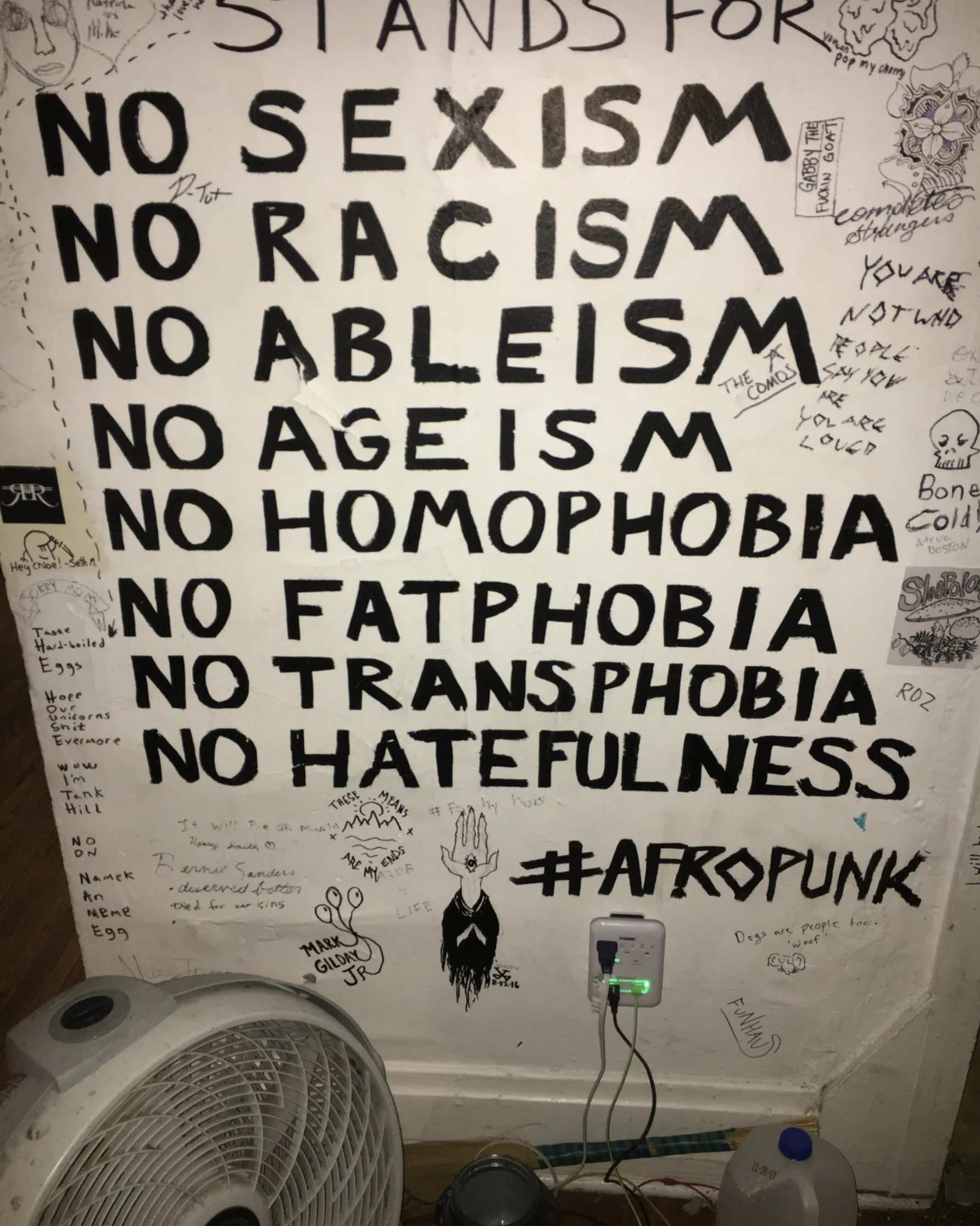
The Afropunk values that some venues operate under, here shown painted onto a living room wall of a venue.
and I think ‘these are pretty much all straight white guys’”. They later on added that that will be the norm in almost any music scene and was to some extent unavoidable, but did also mention venues in Columbus that do go the extra mile to book a show of all queer bands or search out bands that have members who are people of color. My other informants, one woman and another non-binary person, expressed that they felt welcome in the community and believed it did a good job at being accepting.
The independent music scene in Columbus and the community it tries to build is a good location to apply the theory of co-culture, which can be used to analyze how already marginalized people, such as people who are LGBT or African-American, exist and interact inside of groups which already occupy a fringe portion of society, such as punk music scenes. Due to their fringe status members often make attempts or at the least claim to make attempts to create inclusive spaces and communities, but as mentioned before with music scenes the predominant members are straight white males. As Rubén Ramírez-Sánchez notes in his paper on the experiences of African-Americans in punk communities, it’s harder for a minority person to feel a sense of belonging to a group when that person is poorly represented in the group or perhaps not represented at all (Ramírez-Sánchez, 96). The same sentiment of feeling underrepresented was brought up by my interviewees, as well as by others I’ve talked to in the past. While it could seem to some that this detracts from a sense of community as white males are the majority of members in the community, I would argue that Columbus to an extent recognizes the problem and tries to address it.
When a show organizer or a person that lives in a house venue is simultaneously LGBT or a minority race or any other minority category, as many organizers in Columbus are, it’s all but impossible for them to ignore the marginalized space they occupy in the scene. Because ofthis, venues in Columbus go out of their way to book shows that feature artists who don’t fit the straight white guy category. As I discussed earlier, the Facebook page for the DIY community is frequently utilized by show organizers to book shows that include artists of different intersections and backgrounds. Because of this commitment to inclusion and representation, the scene feels more welcoming to marginalized members of society and allows them to feel more comfortable.
Another aspect of the DIY community that builds a sense of insider status is that of clothing and accessories of certain members. This can include aspects present in typical music culture such as an increased amount of people wearing tee-shirts of popular bands at shows, but this can take on a different role when regarding the DIY scene. In my research at shows, I found that merchandise such as tee-shirts or stickers of local bands, as well as merchandise bought from a show that was held at a DIY venue, was a popular conversation starter between attendees or performers at a show. Strangers would often engage conversation over one party’s shirt, noting that they’re friends with a member in band if it was a local band or that they were also at the show where the shirt was purchased and would talk about their experiences at it. Wearing the merchandise of local artists and bands that have performed at local venues not only acts as a way to gauge someone else’s taste in music and potentially bond over that, but also functions as a way of showing one’s insider status in the group. Displaying this insider status gives others who are also a part of the group a reason to approach someone and make conversation about local music.
Another common clothing practice is that of buying patches, either from bands in person or buying patches of popular bands online, and sewing them onto pants and jackets. It should be noted that this activity is predominantly practiced by members who are mostly into punk rock, asthe activity originated in that area and is still prevalent there. While this practice is not specific to the Columbus music scene, like with tee-shirts of local bands having local patches both shows one’s insider status in the community as well as displays bands one enjoys. Beyond supporting local musicians, putting patches on clothing very literally exhibits the “do it yourself” ethic the community is named for. While patches can be applied purely for aesthetic reasons, often times they’re hand-sewn onto existing rips and holes in clothing to extend their use.
When doing my research on secondary sources for my project, I read an article that made me consider to what degree the Columbus DIY music scene was a community as opposed to a group of people with common interests. The article in question was Longing for Community by Burt Feintuch, a respected and accomplished folklorist who has wrote a litany of pieces on musical ethnography. In his article, Feintuch criticizes folklorists for being too liberal with their use of the word community, and without fully considering what the word implies. Feintuch explains that in his mind, “community [is] more than what happens in one, occasional sphere of interaction. To be in community is to participate in a web of connectedness to others that continues beyond special events” (Feintuch, 149). This caused me some distress as I considered if I had been using the word community too loosely regarding my project. But after further considering the subject, I believe Feintuch’s view of what constitutes community is a bit too restrictive and that to me, the Columbus DIY scene is worthy of being called a community.
Some of the main reasons that I came to this conclusion are the fact that members of the group invest so much effort in making the space inclusive, and because relationships between members go beyond just interacting at shows. To me, the fact that members in the community go to such lengths to make sure that the environment is as welcoming as can be attests to their attitudes of wanting to make the scene feel like a community to all members. Organizers andparticipants care about the experiences of others in the group and want to provide the safe space that the scene claims to be. Along with this, interactions between insiders don’t happen exclusively at shows. After becoming seeing another person at a show frequently enough or becoming familiar with someone in the group, many people will add each other on Facebook to stay connected and up to date on each other’s lives. In doing this the relationship between members changes from strictly interacting at shows to being kept more or less up to date with their life, and it allows genuine friendships to emerge independent of music or venues.
As shown in this paper and as I’ve become more aware of in doing this research, the Columbus DIY music community is a complicated but interesting subject. In setting itself apart from mainstream music culture, it allows for unique practices and ways of operating that could only function on a small scale. But the most important thing the scene offers to its members is a sense of belonging to a group that reaches beyond music and is incorporated into other facets of life. Through the cooperation of all of its participants, it allows something as broad and all- encompassing as music culture to feel locally defined and communal to its members.
1. Cisgendered is the terminology used to refer to people who identify as the sex they were assigned at birth, opposed to transgendered and gender non-binary people
Works Cited
Ramírez-Sánchez, Rubén. “Marginalization from Within: Expanding Co-Cultural Theory through the Experience of the Afro Punk.” Howard Journal of Communications, vol. 19, no. 2, Apr-Jun 2008, pp. 89-104. EBSCOhost, doi:10.1080/10646170801990896
Feintuch, Burt. “Longing for Community.” Western Folklore, vol. 60, no. 2/3, 2001, pp. 149–161., www.jstor.org/stable/1500374.