October 21, 2026
"One Event, Different Memories:" Bringing Art and Collective Memory into the Folklore Classroom


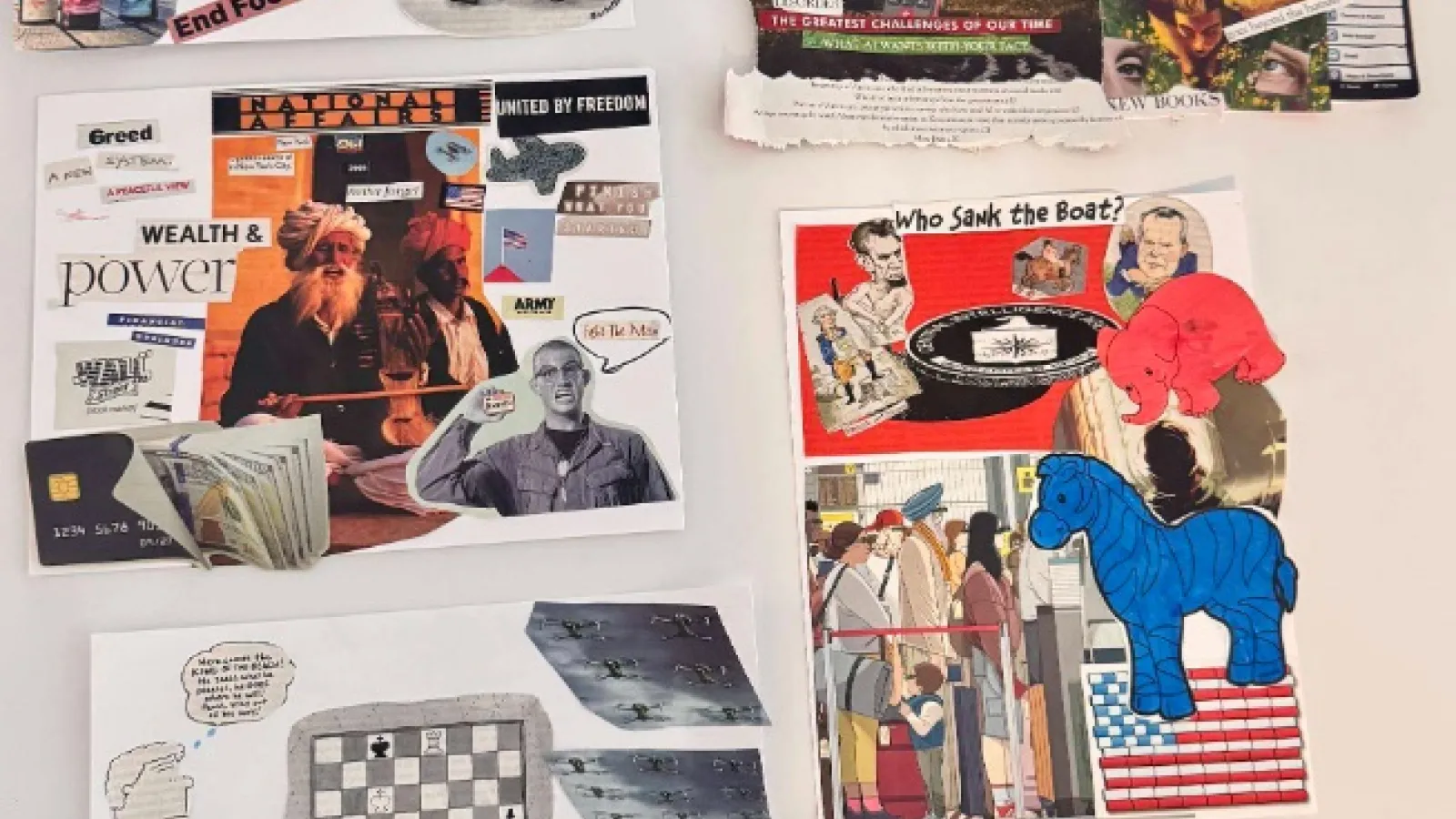
On October 20, in Room 2015 of MacPherson Hall, an Introduction to Folklore class taught by Zahra Abedi took a colorful turn. Nursing a broken toe and a foot injury, I was not feeling my best, so I decided to change the rhythm of our classroom and invite art into our discussion. My students welcomed the experiment with creativity, enthusiasm, and thoughtful engagement, turning an uncomfortable day into a memorable teaching experience. We began by discussing Alessandra Miklavcic’s “Slogans and Graffiti: Postmemory among Youth in the Italo-Slovenian Borderland” (2008), exploring how historical events, public symbols, and collective memories acquire different meanings across communities and generations. Then, in six groups of approximately five, students exchanged their usual notes for scissors, magazines, glue, and paper, creating collages that explored how the same event, cultural practice, or symbol can tell different stories depending on who remembers, interprets, or represents it.
The resulting collages transformed our classroom into a small exhibition of competing memories and cultural interpretations. Students explored political polarization and competing narratives of American history; technological change and AI and generational understandings of privacy and communication; fasting and food marketing, and the cultural meanings attached to bodies and consumption; and war, political power, and contrasting perspectives on drone technology and modern warfare among citizens and political leaders; and the changing memories of September 11, from those who experienced its immediate aftermath to generations who know it primarily through inherited narratives.
The technology collage juxtaposed images of books, smartphones, screens, and surveillance with phrases such as “Cyber Scare,” “Tomorrow,” and “The First Casualty Will Be Your Privacy,” raising questions about how technological knowledge, concerns about privacy, and attitudes toward AI circulate differently among generations. Another group examined September 11 and how its meanings have changed through the passage of time: from the immediate experiences and memories of those who lived through the attacks to younger generations who encounter the event through stories, images, commemorations, and other forms of cultural transmission.
One collage used a chessboard, images of war, and political cartoons to explore how conflict and power are represented, while another juxtaposed historical political figures, contemporary symbols, and the question “Who Sank the Boat?” In their reflections, students emphasized how different communities interpret the same symbols and events through distinct histories, experiences, and cultural frameworks. Their collages also illustrated how cultural transmission is not merely the preservation or repetition of inherited narratives, but an ongoing process through which memories are selected and which meanings are passed down and reinterpreted across generations.
Their work reminded me that folklore is not simply about preserving the past; it is also about the ways people continually reinterpret it, sometimes in agreement and sometimes in conflict. What began as an attempt to make a difficult day a little easier became a reminder of the unexpected possibilities of teaching: sometimes, when we change the format of a classroom, students find new ways to make knowledge visible.